


Hip impingement syndrome, medically known as Femoroacetabular Impingement (FAI), is a hip condition that develops when the bones forming the hip joint come into abnormal contact during movement.
Most common symptoms: Groin pain, a catching sensation in the hip, restricted range of motion, and discomfort that increases during sports activities.
Key information: If hip impingement syndrome progresses without appropriate treatment, labral tears and cartilage damage may develop, potentially contributing to hip osteoarthritis over time.
Treatment approach: In the early stages, activity modification, physical therapy, and muscle strengthening may be recommended. If structural impingement persists and symptoms do not improve, hip arthroscopy may be considered in appropriately selected patients.
What Is Hip Impingement Syndrome?
Hip impingement syndrome occurs when there is excessive contact between the femoral head-neck junction and the acetabulum (hip socket). This can cause friction during movement, irritation of tissues within the joint, and pain over time.
The hip is a ball-and-socket joint. The femoral head should move smoothly within the socket. However, bony prominences, excessive socket coverage, or variations in bone shape can lead to impingement during hip movement.
FAI, also known as femoroacetabular impingement, may cause more noticeable symptoms in young, active individuals, athletes, and people who frequently perform activities involving deep hip flexion.
Important: Hip impingement syndrome is not simply a cause of pain. If left unaddressed for a prolonged period, it may contribute to progressive labral and cartilage damage, potentially affecting the long-term health of the hip joint.
Anatomy of the Hip Joint
The hip joint is formed by the femoral head and the acetabulum of the pelvis. The joint surfaces are covered with articular cartilage. A ring of fibrocartilage called the labrum surrounds the acetabulum.
The labrum contributes to hip joint stability and helps maintain the femoral head securely within the socket. In FAI, abnormal contact can damage the labrum and articular cartilage.
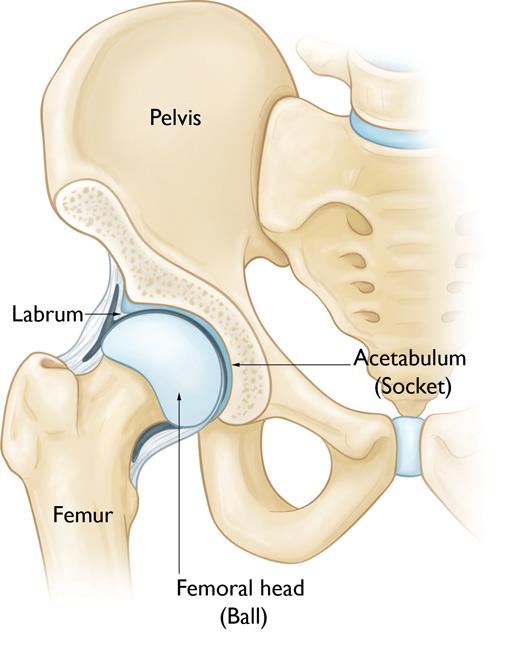

In hip impingement syndrome, structural variations at the femoral head-neck junction or along the rim of the acetabulum can cause abnormal contact during hip movement.
What Are the Types of FAI?
Hip impingement syndrome is generally classified into three types: cam, pincer, and combined impingement. Unlike a fracture or acute traumatic injury, FAI is usually related to the shape of the bones forming the hip joint and how they interact during movement.
1. Cam-Type FAI
Cam-type FAI occurs when there is a bony prominence or abnormal contour at the junction between the femoral head and neck. This prominence can come into contact with the acetabular rim during hip movement, causing impingement.
Possible consequences of cam-type hip impingement:
- Increased friction within the joint
- Labral damage
- Wear or damage to articular cartilage
- Groin pain
- Restricted hip range of motion
2. Pincer-Type FAI
Pincer-type FAI occurs when the acetabulum provides excessive coverage of the femoral head or when excess bone is present along the acetabular rim. As a result, the femoral neck may come into contact with the socket rim during movement.
In pincer-type impingement, the labrum can become compressed between the acetabular rim and the femoral neck. Over time, this may lead to labral tears and pain within the joint.
3. Combined-Type FAI
Combined-type FAI involves both cam and pincer features. It is a commonly encountered form of hip impingement, with structural abnormalities affecting both the femoral head-neck junction and the acetabulum.
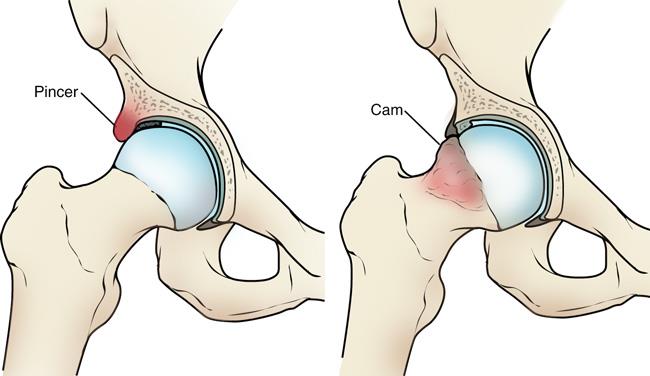

Cam-type FAI involves a bony prominence at the femoral head-neck junction, whereas pincer-type FAI involves excessive acetabular coverage or a bony prominence along the socket rim.
What Causes Hip Impingement Syndrome?
Hip impingement syndrome most commonly results from variations in the shape of the bones forming the hip joint. In some individuals, these structural characteristics develop during childhood or adolescence, while intensive sports participation may cause symptoms to appear earlier in others.
Factors that may contribute to FAI:
- Congenital or developmental variations in bone shape
- Formation of a bony prominence at the femoral head-neck junction
- Excessive coverage of the femoral head by the hip socket
- Intensive sports activities
- Repetitive hip flexion and rotational movements
- High levels of physical activity at a young age
Note: Not every variation in bone shape causes pain. Some people have hip morphology associated with FAI but experience no symptoms. Treatment decisions should be based on symptoms and clinical examination findings, not imaging alone.
Which Sports May Increase the Risk of Symptoms?
Sports involving frequent hip flexion, rotation, sudden changes of direction, and squatting may aggravate FAI symptoms. Particularly in young athletes, groin pain and reduced athletic performance should prompt consideration of hip impingement syndrome.
Sports and activities that may aggravate FAI symptoms:
- Football (soccer)
- Basketball
- Dance
- Running
- Fitness training
- Weightlifting and exercises involving deep squats
- Hockey, tennis, and sports requiring sudden changes of direction
What Are the Symptoms of Hip Impingement Syndrome?
Symptoms of hip impingement syndrome may develop gradually. Patients commonly describe groin pain, a catching sensation in the hip, or sharp pain during sports activities.
Most common symptoms of FAI:
- Groin pain
- A sharp or pinching sensation at the front of the hip
- Difficulty sitting down or standing up
- Catching or clicking in the hip
- Restricted range of motion
- Pain during sports activities
- Discomfort after prolonged sitting
- Pain during squatting or rotational movements
Most typical finding: Pain associated with hip impingement syndrome is most often felt in the groin. In some patients, it may radiate to the outer hip or thigh.
When Does the Pain Get Worse?
FAI-related pain may increase during movements involving hip flexion, internal rotation, or positions that bring the joint into impingement. As a result, certain everyday activities can cause significant discomfort.
Situations that may increase pain:
- Prolonged sitting
- Getting out of a car
- Squatting
- Tying shoelaces
- Climbing stairs
- Bending forward
- Changing direction during sports
- Deep squats or movements involving substantial hip flexion
When Should Symptoms Be Taken Seriously?
Symptoms of hip impingement syndrome may be mild at first. However, assessment should not be delayed if groin pain recurs, hip mobility becomes increasingly restricted, or athletic performance declines.
- Persistent or recurring groin pain
- Catching or clicking in the hip
- Development of restricted hip movement
- A noticeable decline in athletic performance
- Pain that persists despite rest
- A labral tear or cartilage damage identified on MRI
Caution: Continuing sports at the same intensity despite hip pain may aggravate labral and cartilage damage. Early assessment is important for protecting hip joint health.
How Is Hip Impingement Syndrome Diagnosed?
Diagnosis of FAI is based on a combination of the patient's symptoms, physical examination findings, and imaging results. MRI or X-ray findings alone are not sufficient for diagnosis; the suspected source of pain must also be supported by the clinical assessment.
Clinical Examination
During the examination, the clinician assesses hip range of motion, groin pain, catching sensations, and specific impingement tests. The FADIR test is one of the clinical tests commonly used when evaluating hip impingement syndrome.
During the FADIR test, the hip is positioned in flexion, adduction, and internal rotation to determine whether the patient's pain can be reproduced. A positive result may support a suspicion of FAI, but the diagnosis is established in conjunction with imaging and the overall clinical examination.

The FADIR test is one of the clinical tests used to assess hip impingement. X-rays and advanced imaging help evaluate the bony anatomy of the joint.
Imaging
Imaging is important for assessing the bony anatomy, labrum, and articular cartilage in patients with hip impingement syndrome.
Imaging methods used in diagnosis:
- X-ray: Helps evaluate cam- or pincer-type bony morphology.
- MRI: Used to assess labral tears, cartilage damage, and soft tissue abnormalities.
- MR arthrography: May provide additional detail in selected cases of suspected labral injury.
- 3D CT: May be used for detailed assessment of the location and size of bony prominences and the anatomy of the hip joint.
Treatment of Hip Impingement Syndrome
Treatment of hip impingement syndrome is planned according to the duration and severity of symptoms, imaging findings, cartilage condition, and the patient's activity goals.
The goals of treatment are to reduce pain, preserve joint mobility, limit further labral and cartilage damage, and support a safe return to everyday activities or sports.
Non-Surgical Treatment
Non-surgical treatment for hip impingement syndrome may be considered as the initial approach, particularly in the early stages and in patients whose symptoms can be managed conservatively.
Non-surgical treatment options may include:
- Activity modification
- Avoiding movements that aggravate pain
- Physical therapy
- Strengthening the muscles surrounding the hip
- Range-of-motion exercises
- Core and gluteal muscle strengthening
- Considering medication or injection treatments when appropriate
In the early stages: Activity modification and an appropriate physical therapy program may help reduce pain in some patients. However, symptoms may recur if the underlying structural impingement remains.
Hip Arthroscopy
Hip arthroscopy is a minimally invasive surgical technique used in selected patients with hip impingement syndrome. A camera and specialized surgical instruments are introduced into the joint through small incisions to reshape the bony prominences responsible for impingement.
If a labral tear accompanies FAI, labral repair may be performed. When cartilage damage is present, the joint surface is assessed and appropriate procedures are planned according to the extent of the damage.
Goals of hip arthroscopy:
- Reshape cam-type bony prominences
- Correct excessive acetabular coverage associated with pincer-type impingement
- Repair or treat labral tears
- Assess cartilage damage
- Reduce impingement during hip movement
- Relieve pain and improve mobility


During hip arthroscopy, a camera and specialized surgical instruments are introduced into the joint through small incisions. In suitable patients, bony prominences can be reshaped and labral tears repaired.
Recovery After Surgery
Recovery following arthroscopy for hip impingement syndrome varies depending on the procedures performed. Labral repair, bone reshaping, and cartilage procedures may all affect the rehabilitation plan.
First Few Weeks
The initial phase focuses on protecting the hip, reducing pain, and ensuring safe mobility. Crutches may be required.
- Pain and swelling management
- Wound care
- Use of crutches
- Following weight-bearing restrictions
- Gentle, controlled movements
Weeks 2–6
During this period, rehabilitation aims to improve range of motion, restore muscle activation, and normalize walking patterns. Physical therapy plays an important role in recovery.
- Improving hip range of motion
- Physical therapy and an exercise program
- Controlled weight-bearing
- Activating the muscles surrounding the hip
- Improving gait mechanics
Weeks 6–12
In the later phase, rehabilitation focuses on strengthening, balance, coordination, and a return to functional activities. The return to sports should be gradual.
- Strengthening exercises
- Balance and coordination training
- Progression to functional exercises
- Gradually increasing activity levels
- Preparation for a return to sports
Return to sports: Following hip arthroscopy, returning to sports may take 3–4 months or longer for many patients. The timeline varies depending on the procedure performed, adherence to rehabilitation, and pain levels.
What Happens If Hip Impingement Syndrome Is Left Untreated?
If hip impingement syndrome is left untreated, repeated friction and impingement may worsen labral damage. Progressive wear of the cartilage surface may increase the risk of developing hip osteoarthritis.
Patients who continue high-intensity sports despite pain may be at greater risk of further damage within the hip joint.
Caution: Early assessment is important when persistent groin pain, a catching sensation in the hip, or restricted mobility is present. In cases with advanced cartilage damage, the potential benefits of arthroscopy may be reduced.
Common Mistakes to Avoid
Common mistakes in managing hip impingement syndrome can delay diagnosis and treatment. In young and active individuals in particular, groin pain may be mistaken for a muscle strain for an extended period.
Common mistakes in FAI management include:
- Ignoring groin pain
- Continuing sports at the same intensity despite pain
- Delaying medical assessment
- Confusing hip joint pain with pain originating from the lower back or muscles
- Making treatment decisions based on MRI findings alone
- Neglecting physical therapy
- Having unrealistic expectations of arthroscopy when advanced cartilage damage is present
Most important mistake: Prolonged delays in assessing hip impingement syndrome may allow labral and cartilage damage to progress.
Hip Impingement Syndrome Treatment in Istanbul
In Istanbul, an evaluation by an orthopedics and traumatology specialist is important for patients experiencing hip impingement syndrome, FAI, femoroacetabular impingement, groin pain, catching sensations in the hip, or hip pain that worsens during sports activities.
Treatment planning should take into account a detailed assessment of the bony anatomy, X-ray and MRI findings, 3D CT imaging when needed, the patient's level of sports participation, and expectations for daily activities.
For patients seeking treatment for hip impingement syndrome on the European side of Istanbul and in the Maslak area, an individualized treatment approach can be planned following clinical examination and imaging assessment by Assoc. Prof. Dr. Gökhan Karademir.
When Should You See a Doctor?
Early assessment of hip impingement syndrome is important for limiting the progression of joint damage. Recurrent groin pain, especially in young and active individuals, should not be overlooked.
An orthopedic evaluation is recommended in the following situations:
- Groin pain
- A catching sensation in the hip
- Pain during sports activities
- Hip pain that worsens after prolonged sitting
- Restricted hip movement
- Pain that becomes more noticeable when squatting, turning, or getting out of a car
- A labral tear or features of FAI identified on MRI
Conclusion
Hip impingement syndrome is a hip joint condition that can often be managed effectively when identified early. If it progresses without appropriate treatment, it may increase the risk of labral tears, cartilage damage, and hip osteoarthritis.
If you experience groin pain, catching sensations in the hip, restricted mobility, or pain during sports activities, an assessment by an orthopedics and traumatology specialist is recommended to establish an accurate diagnosis and develop an individualized treatment plan.
Frequently Asked Questions
Is FAI a serious condition?
FAI can be a significant hip condition. If symptomatic hip impingement progresses without appropriate treatment, it may increase the risk of labral tears, cartilage damage, and hip osteoarthritis.
Can I play sports with hip impingement syndrome?
If you have pain, you may need to temporarily stop sports or modify your activities. Whether you can continue participating depends on the severity of your pain, clinical examination findings, and treatment plan.
Is surgery always necessary for hip impingement syndrome?
Not every patient requires surgery. In the early stages, physical therapy, activity modification, and muscle strengthening may be sufficient. However, if structural impingement persists and symptoms do not improve, hip arthroscopy may be considered.
Is there a long-term solution for hip impingement syndrome?
With appropriate treatment, pain can be reduced, mobility improved, and progression of joint damage potentially slowed in suitable patients. Careful patient selection and rehabilitation are important for achieving good outcomes.
Is an MRI necessary to diagnose FAI?
MRI is often used to assess labral tears and cartilage damage. While X-rays show the bony anatomy, MRI provides information about the soft tissues within the joint.
What is the most common symptom of hip impingement syndrome?
The most common symptom is groin pain. It may become more noticeable when sitting down or standing up, squatting, getting out of a car, or participating in sports.